

ANWR Group: High-Performance for Millions of Product SKUs
5M+
Product SKUs managed centrally
80%
Faster product data sync

B2B and B2C commerce built to handle real catalogue complexity. We launched it in 90 days for Franke and scaled it to millions of SKUs for industrial distributors. We know what it takes.
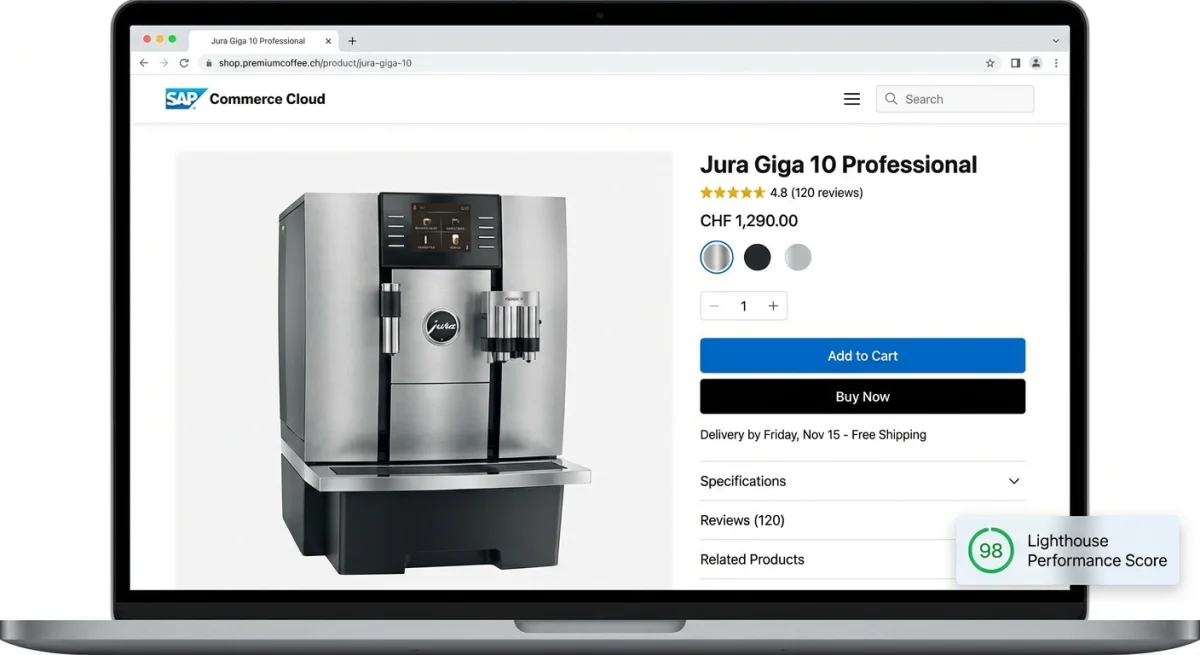
Headless React-based frontend decoupled from the commerce engine. Performance, flexibility, and full control over the customer experience.
Account-based pricing, punch-out, order approval workflows, and reorder lists. Everything a B2B buyer expects.
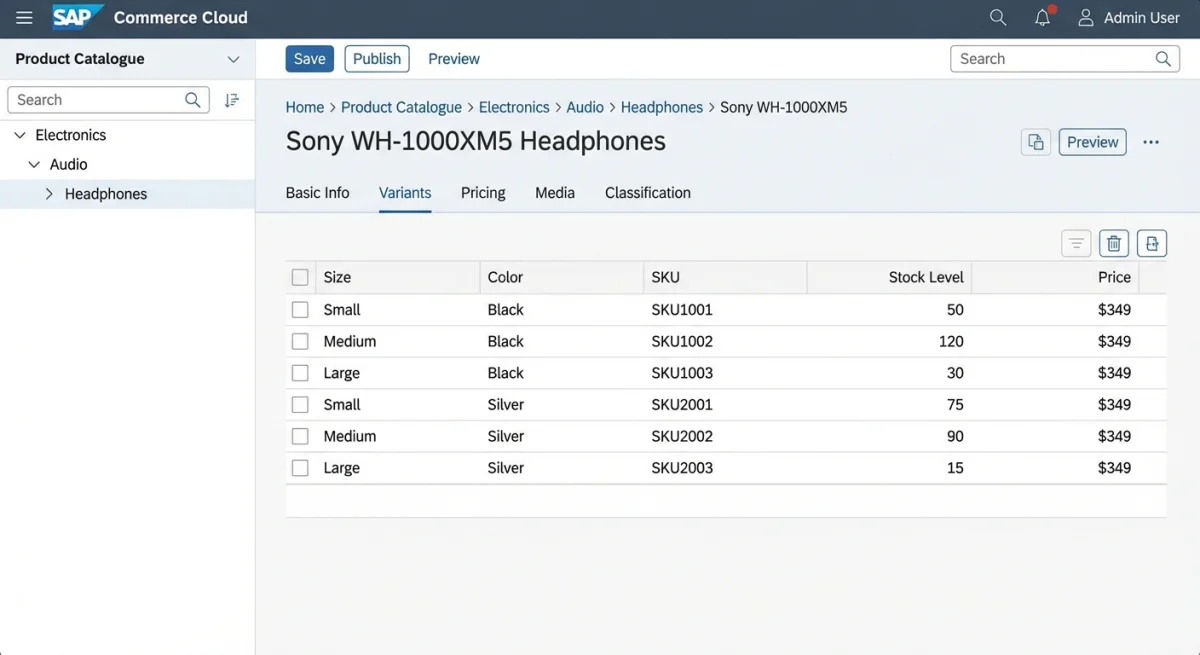
Rich product catalogue with variants, bundles, and localisation. Works with millions of SKUs without performance compromises.
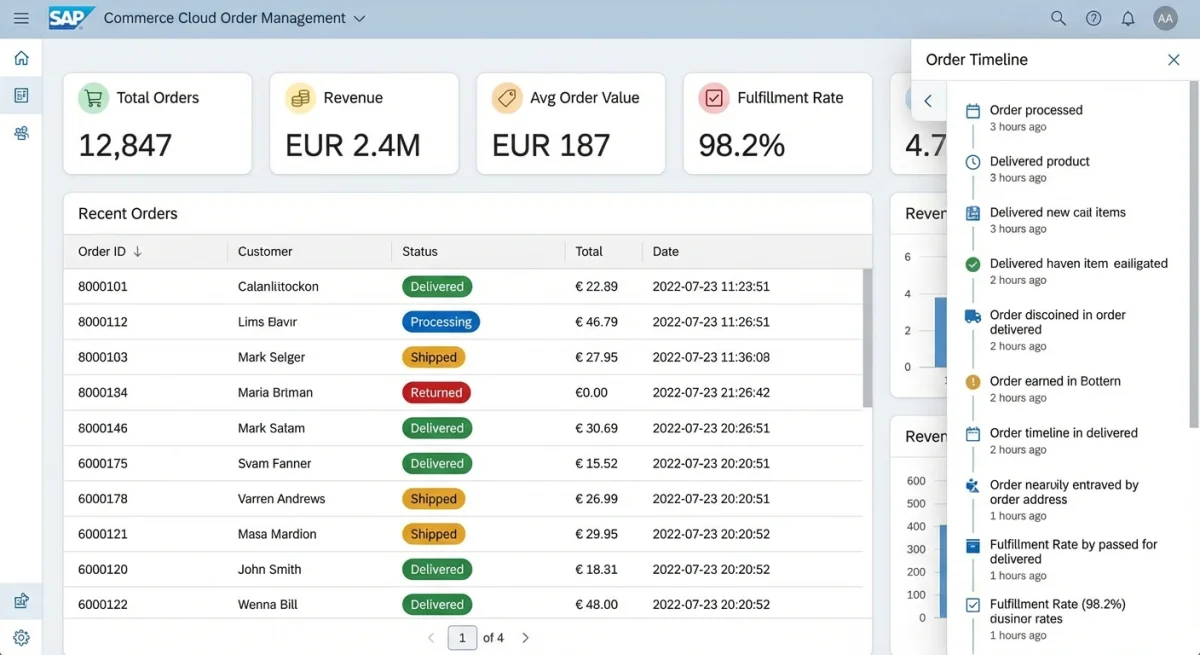
Multi-warehouse, multi-channel order orchestration. Returns, splits, and backorder handling out of the box.
Segment-based content and promotions. Serve different experiences to different customer groups without custom development.
Real-time pricing, stock levels, and order data from SAP ECC and S/4HANA. No overnight batch jobs.
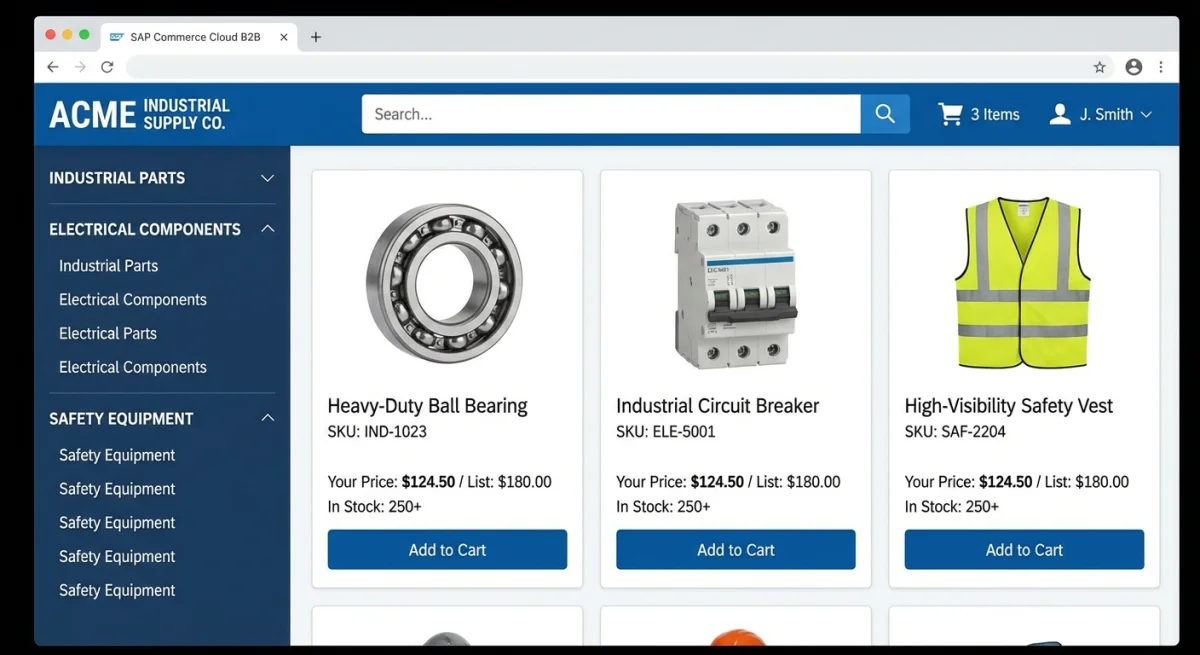
Our track record in SAP Commerce Cloud is long and specific. We built Franke’s award-winning B2B platform in 90 days — a project that replaced a stalled custom build and won an SAP Quality Award. We’ve migrated distributors off legacy hybris accelerators to SAP Commerce Cloud Composable Storefront. We’ve scaled catalogue management for companies with 3+ million SKUs across multiple countries and languages.
As an SAP Gold Partner with offices in Switzerland, Italy, Austria, and Estonia, we bring local presence across the DACH region and Southern Europe. No offshore handoffs. The architects who scope your project are the same people who configure your storefront and train your team. When something breaks at 8 AM on a Monday, you call someone in your time zone.
What we handle end to end:
Our delivery follows SAP Activate methodology — five phases from discovery through hyper-care — adapted for SAP Commerce Cloud projects. Discovery takes two weeks. We map your catalogue structure, pricing rules, order workflows, and integration points before a single line of code is written.
For a full technical overview of the platform — from product content management to order orchestration — see our SAP Commerce Cloud A-Z Handbook.
Our most-cited project. Franke had a stalled custom B2B e-commerce build. We replaced it with SAP Commerce Cloud in 90 days — composable storefront, B2B pricing, full SAP ERP integration. The result: an SAP Quality Award for implementation quality and a platform that now serves Franke’s global distribution network. Read the full Franke story for the timeline, migration approach, and lessons learned.
E-commerce projects live or die on numbers. Here’s what SAP Commerce Cloud implementations deliver when done right:
These are not theoretical. Our clients see order error rates drop by 80%+ after moving from phone/fax ordering to online self-service. The most immediate gain is cost-to-serve: every order that goes through self-service instead of a phone call saves your inside sales team 15–20 minutes. Multiply that by hundreds of orders per week.
The ROI case typically pays back the implementation cost within 12–18 months. Calculate your projected return based on your order volume and average transaction size.
The analyst community has consistently recognised SAP Commerce Cloud. In the 2025 Gartner Magic Quadrant for Digital Commerce, SAP was named a Leader for the 11th consecutive year — the only vendor to hold the position unbroken since the report’s inception in 2014. That is not momentum from a legacy install base — it reflects continued investment in composable architecture, B2B capabilities, and AI-driven personalisation.
SAP Commerce Cloud is also a Leader in both the IDC MarketScape for Enterprise B2B Digital Commerce (2023–2024) and the IDC MarketScape for Enterprise B2C Digital Commerce (2024).
On G2 (based on verified user reviews, 2025):
| Category | SAP Commerce Cloud | Shopify Plus | Adobe Commerce |
|---|---|---|---|
| Overall Rating | 4.0 | 4.4 | 4.0 |
| Ease of Use | 8.4 | 8.9 | — |
| Quality of Support | 8.6 | 8.4 | — |
Shopify Plus leads on ease of use — expected for a platform designed for rapid setup and smaller catalogues. SAP Commerce Cloud scores higher on quality of support and matches Adobe Commerce overall despite serving a more complex B2B market. For organisations already running SAP ERP, the integration advantage compounds the platform advantage. For head-to-head comparisons, see our SAP Commerce Cloud vs Shopify Plus and vs Adobe Commerce analysis pages.
Platform reliability at scale: During Cyber Week 2025, SAP Commerce Cloud processed $17.8 billion in gross merchandise value (up 40% year-over-year) with 100% platform uptime. The previous year saw 18.2 million orders during the same peak period — again, zero downtime (source: SAP Commerce Cloud Year in Review, 2025).
If you’re starting fresh or replacing an older hybris accelerator, composable storefront is the right direction. SAP Commerce Cloud Composable Storefront (formerly Spartacus) decouples the frontend from the commerce engine entirely. The storefront is a React-based progressive web app (PWA) that talks to the commerce backend via OCC REST APIs.
What that means in practice:
When to use the accelerator instead: If you need an internal B2B portal where function matters more than UX, and you want to go live in 6–8 weeks, the accelerator approach still works. It’s faster to configure, requires less frontend skill, and covers 80% of B2B self-service needs out of the box. We’ll tell you which fits your situation — not the one that maximises project scope.
For a deeper dive on composable architecture, OCC APIs, and implementation patterns, see our SAP Commerce Cloud A-Z Handbook.
This is a question we get every week. If you’re running SAP Hybris on-premise, the clock is ticking. SAP has been directing all new feature development to the cloud version since 2020. The on-premise version still gets security patches, but no new capabilities.
Our migration methodology:
We don’t rip and replace. We’ve developed a phased approach based on what we learned migrating Franke — which won an SAP Quality Award:
Go-live happens at week 8 — before you’ve finished the migration. Customers get a better experience immediately. The backend migration happens behind the scenes.
What trips people up: Data migration is not a copy-paste job. Product classifications, price lists with thousands of condition records, and customer-specific catalogue views all need validation. We build automated migration scripts with data quality checks at every stage. If your legacy system has 50,000 products with incomplete attributes, we catch that in week one — not week twelve.
The other common mistake is trying to replicate every customisation from the old system. Most organisations discover that 30–40% of their legacy extensions are no longer needed. We help you separate what matters from what was built to work around old platform limitations.
We documented the full playbook — timelines, risk mitigation, and data migration patterns — in our 90-day migration playbook. It’s based on real projects, not theory.
SAP Commerce Cloud licensing is based on gross merchandise volume (GMV) and traffic tiers, not a simple per-user price. That makes direct comparison tricky, but here’s a realistic picture:
| SAP Commerce Cloud | Shopify Plus | Adobe Commerce (Magento) | |
|---|---|---|---|
| Pricing model | GMV + traffic tiers | Revenue-based (0.25% of GMV over $800K) | Licence + GMV tiers |
| Annual licence (mid-market) | EUR 150K–500K+ | EUR 24K–180K+ | EUR 40K–200K+ |
| B2B features | Native: punch-out, account pricing, approval workflows | Limited, requires apps | Available with B2B module |
| SAP ERP integration | Native, real-time | Third-party middleware | Third-party middleware |
| Multi-country / multi-brand | Built-in with shared catalogue | Separate stores (Plus only) | Multi-store with shared backend |
| Composable / headless | Yes (Composable Storefront) | Hydrogen (newer) | PWA Studio / Hyva |
| Hosting | SAP-managed cloud (Azure) | Shopify-managed | Self-hosted or Adobe-managed |
The real cost question is total cost of ownership. If you’re already running SAP ERP, Commerce Cloud eliminates the middleware layer you’d need with Shopify Plus or Adobe Commerce. Real-time pricing, stock, and order sync come out of the box. For companies doing EUR 10M+ in online revenue with complex B2B requirements, SAP Commerce Cloud typically delivers lower TCO over a 3-year period despite higher licence costs.
Spadoom offers fixed-price implementation packages. You know the full investment — licence, implementation, training, and hyper-care — before signing. No surprise change requests at month four.
SAP Commerce Cloud is built for catalogue complexity and process depth. Here’s where we’ve deployed it:
Manufacturing and industrial distribution — The core use case. Distributors with 500,000+ SKUs need customer-specific pricing, multi-warehouse stock visibility, and order approval workflows. We configure punch-out catalogues for procurement system integration (SAP Ariba, Coupa) and set up reorder lists that let buyers repeat last month’s order in two clicks. Real-time stock and pricing from S/4HANA means no more “sorry, that price changed” emails after order submission. For companies with field sales teams, the same platform serves both the self-service portal and the sales rep’s order entry — same prices, same stock, one system.
Consumer goods and retail — B2C brands with high SKU counts, seasonal catalogues, and multi-country storefronts. SAP Commerce Cloud handles localised content, currency, tax rules, and shipping per market — all from a single catalogue. The personalisation engine serves different promotions to different customer segments without custom code. One catalogue, one order management system, one integration layer — but each country gets its own storefront, pricing, and fulfilment logic.
Automotive aftermarket — Parts catalogues are a special kind of complex. Vehicle fitment data, supersession chains, and cross-reference lookups on top of standard e-commerce. We’ve built SAP Commerce Cloud storefronts that integrate with TecDoc and ETKA catalogues, serving the right parts for the right vehicle without forcing buyers to know part numbers.
Food and beverage — B2B ordering with minimum order quantities, case-pack logic, delivery window scheduling, and temperature-controlled logistics integration. SAP Commerce Cloud’s order management handles split shipments across multiple warehouses and delivery routes. Route accounting integration with SAP ERP closes the loop from order to delivery to invoice. We’ve configured recurring order schedules that let restaurant and hospitality buyers set up weekly standing orders — reducing manual reordering to zero for their top 50 products.
SAP Commerce Cloud’s strongest differentiator is how it connects to the rest of your SAP landscape. This is not an abstract benefit — it directly affects your order accuracy, pricing consistency, and operational efficiency.
S/4HANA and ECC integration — Real-time, bidirectional. When a customer checks product availability on your storefront, they see live stock from S/4HANA. When they place an order, it flows into SAP as a sales order — no CSV imports, no batch jobs, no reconciliation. Pricing comes from SAP’s condition records, so the price online is always the price in ERP.
SAP Emarsys (marketing automation) — Connect your commerce data to Emarsys for abandoned cart recovery, post-purchase campaigns, and personalised product recommendations based on browsing and purchase behaviour. The integration is pre-built. Campaign performance data flows back into commerce analytics.
SAP Customer Data Platform — Unify customer profiles across your storefront, service desk, and marketing channels. CDP collects behavioural data from Commerce Cloud (product views, searches, purchases) and combines it with CRM and service interactions. The result: a single customer view that powers personalisation across every touchpoint.
SAP Customer Identity (CIAM) — Enterprise-grade authentication and consent management for your storefront. Single sign-on across multiple brand sites, progressive profiling, and GDPR-compliant consent tracking. Essential for multi-brand or multi-country deployments where customers expect one login across all your properties.
When these systems work together, you get something that Shopify and Adobe cannot replicate: a commerce platform that knows your customer across sales, service, marketing, and ERP — with data flowing in real time, not via nightly syncs. A B2B buyer who called your service desk yesterday sees a follow-up banner when they log in today. A marketing campaign targeting high-value customers uses actual purchase data, not guesses. That’s the difference between connected systems and a collection of tools.
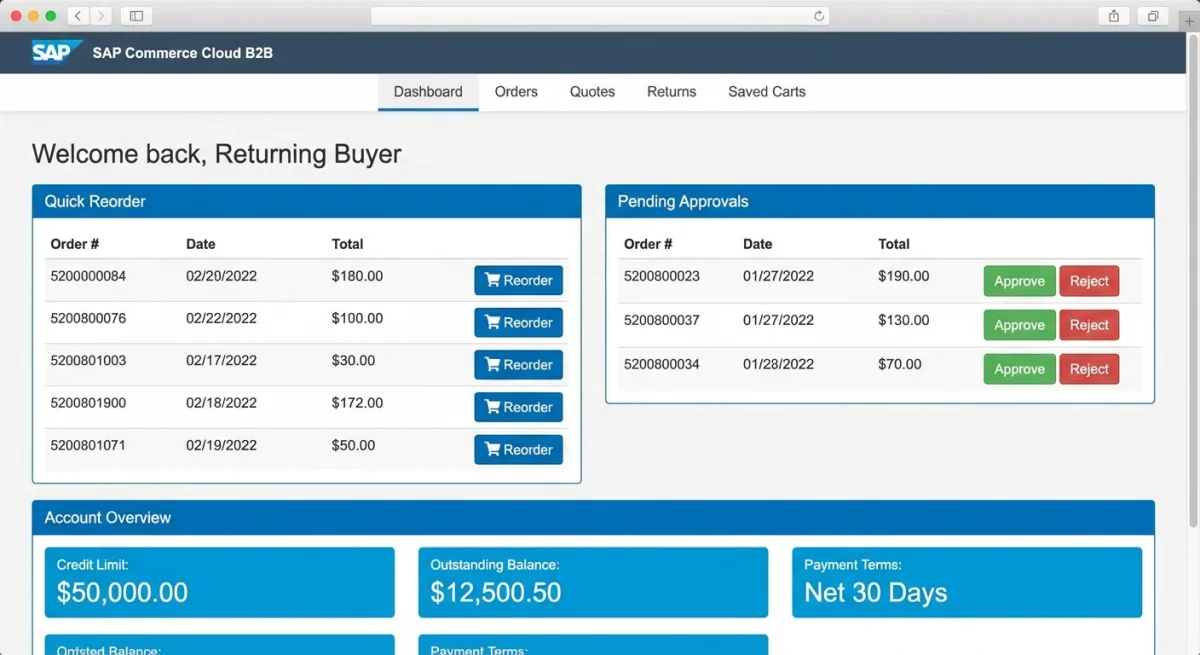
A well-implemented SAP Commerce Cloud means:
Six months after go-live, these numbers tell the story. We track them, and we stay accountable through hyper-care and beyond.
Ready to discuss your SAP Commerce Cloud project? Whether you’re building a new storefront, migrating from on-premise hybris, or replacing a platform that’s holding you back — we’ll give you an honest assessment. Start the conversation or explore our CRM in 10 Days package if you’re also looking at SAP Sales Cloud.


SAP Commerce Cloud (formerly SAP Hybris) is SAP's enterprise e-commerce platform for B2B and B2C online selling. It provides a product catalogue engine, customer-specific pricing, order management, personalisation, and real-time integration with SAP ERP for inventory and pricing data. It supports both traditional accelerator and modern composable storefront (headless) architectures.
SAP Commerce Cloud Composable Storefront (formerly Spartacus) is a JavaScript-based, headless frontend for SAP Commerce Cloud. It decouples the presentation layer from the commerce backend, enabling faster page loads, independent frontend deployments, and a modern React-based PWA experience. Composable Storefront is the recommended path for new implementations and accelerator migrations.
Yes. SAP Commerce Cloud has extensive B2B features including account-based pricing, punch-out catalogues, order approval workflows, customer-specific product visibility, reorder lists, and integration with SAP CPQ for guided selling. It is used by large B2B manufacturers and distributors managing complex catalogues of millions of SKUs.
SAP Hybris (on-premise SAP Commerce) has been transitioning customers to SAP Commerce Cloud (cloud-hosted). Customers still running on-premise should assess their migration path. Spadoom offers a structured migration programme covering platform assessment, composable storefront architecture, and phased go-live — allowing customers to launch on the cloud version before fully decommissioning on-premise.
SAP Commerce Cloud and Shopify serve different market segments. Shopify is a SaaS platform optimised for fast setup and smaller catalogues, while SAP Commerce Cloud is built for enterprise-grade complexity — multi-country rollouts, B2B account hierarchies, customer-specific pricing, punch-out integration, and real-time SAP ERP connectivity. Organisations that need deep back-office integration, complex product configuration, or multi-brand storefronts with shared catalogue infrastructure typically outgrow Shopify and require a platform like SAP Commerce Cloud. For a detailed feature-by-feature breakdown, see our SAP Commerce Cloud vs Shopify Plus comparison page.
SAP Commerce Cloud does not have a fixed list price. Licensing depends on your gross merchandise volume (GMV), traffic tiers, and which modules you use (B2B, B2C, composable storefront, order management). Annual licence costs for mid-market companies typically range from EUR 150,000 to EUR 500,000+. Implementation costs vary with catalogue size, integration complexity, and number of storefronts. Spadoom offers fixed-price implementation packages so you know the full investment before signing. Contact us for a tailored estimate based on your business model.
SAP Commerce Cloud is used across manufacturing, industrial distribution, consumer goods, automotive and aftermarket, food and beverage, and high-tech. It is especially strong in B2B environments with complex product catalogues, customer-specific pricing, multi-country rollouts, and deep SAP ERP integration. B2C use cases include consumer brands with high SKU counts and omnichannel requirements. Spadoom has implemented it for clients across Switzerland, Germany, Austria, and Italy.
Our E-Commerce team has done this before — across manufacturing, retail, and financial services. Let's talk about what's realistic for your situation.
Request a ProposalTrusted by leading European companies










Leave your details and we'll schedule a personalised SAP Sales Cloud V2 & Service Cloud V2 demo for your team.
Your message has been received. We'll be in touch shortly.
Something went wrong. Please try again or email info@spadoom.com.