

AXA: From a Rigid On-Premise World to the Agile Azure Cloud
0%
Downtime during migration
-40%
Lower operating costs

B2B CRM that closes the gap between pipeline fantasy and reality. We've deployed it for manufacturers and distributors across Europe — with adoption rates that hold six months post-go-live.
Machine learning trained on your actual pipeline data — not generic benchmarks. Know where deals stand before your managers have to ask.
Every interaction, opportunity, and order history in one place. SAP Sales Cloud combined with Customer Data Platform features, gives reps a unified profile built from web behaviour, service tickets, and ERP transactions, so they walk into calls prepared, not guessing.
Full CRM capability on any device, online or offline. No excuses for missed updates in the field.
Track deals through every stage with configurable pipelines that match how your team actually sells.
Pre-built connectors for SAP ECC and S/4HANA. Pricing, stock, and order data flow both ways — no manual reconciliation.
Real-time dashboards for reps and managers. Spot slow deals, coaching opportunities, and quota risk without pulling reports.
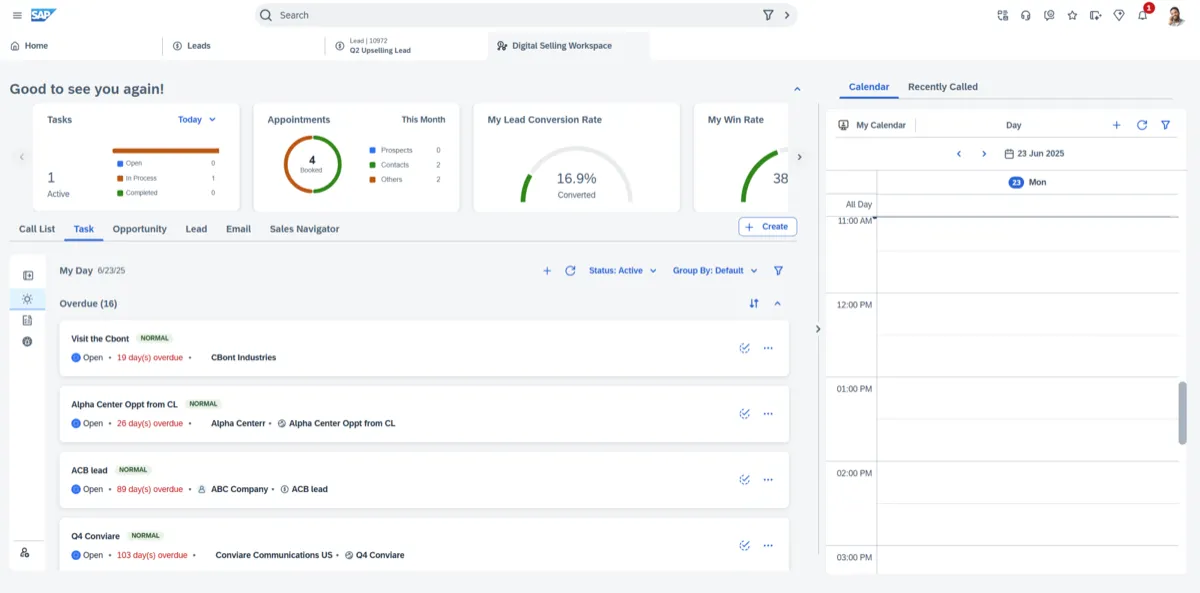
We’ve implemented SAP Sales Cloud V2 for manufacturers, medical device companies, and industrial distributors across Switzerland, Germany, Austria, and Italy. As an SAP partner based in the DACH region, we bring local presence and hands-on project delivery — no offshore handoffs.
Our implementations include custom pipeline configurations, integration with SAP ERP and S/4HANA, territory and quota management, and end-user training that gets people using the system on day one. Adoption is not an afterthought. Our delivery follows SAP Activate methodology — five phases from discovery through hyper-care — adapted for Sales Cloud V2 projects.
We also run SAP Sales Cloud V2 for our own sales pipeline. Every workflow we recommend to a client, we’ve tested on ourselves first. For a full overview of the platform, see our SAP Sales Cloud V2 handbook.
SAP reports that organisations using Sales Cloud V2 see concrete results:
These are not theoretical gains. Our clients in manufacturing and distribution report pipeline review meetings dropping from 90 minutes to 20, and new reps reaching quota-carrying status in half the onboarding time. Calculate your projected ROI based on your deal size and team size.
SAP Sales Cloud V2 ships with Joule, SAP’s AI assistant, embedded directly in the CRM. This is not a bolt-on — Joule runs inside the sales workspace:
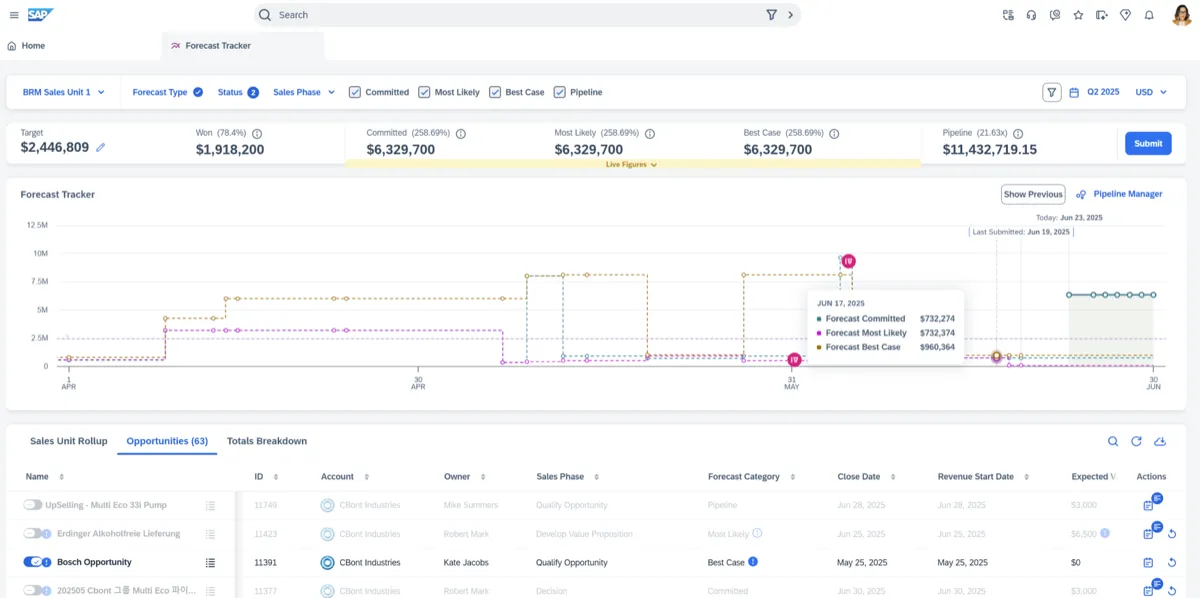
With Joule Studio (GA since Q1 2026), you can build custom AI agents — for example, an agent that pulls product availability from S/4HANA and drafts a delivery timeline email, without the rep leaving Sales Cloud. For a hands-on walkthrough, see our Joule in SAP Sales Cloud V2 guide. For the broader picture of AI agents in SAP CX, read what agentic AI means for sales teams.
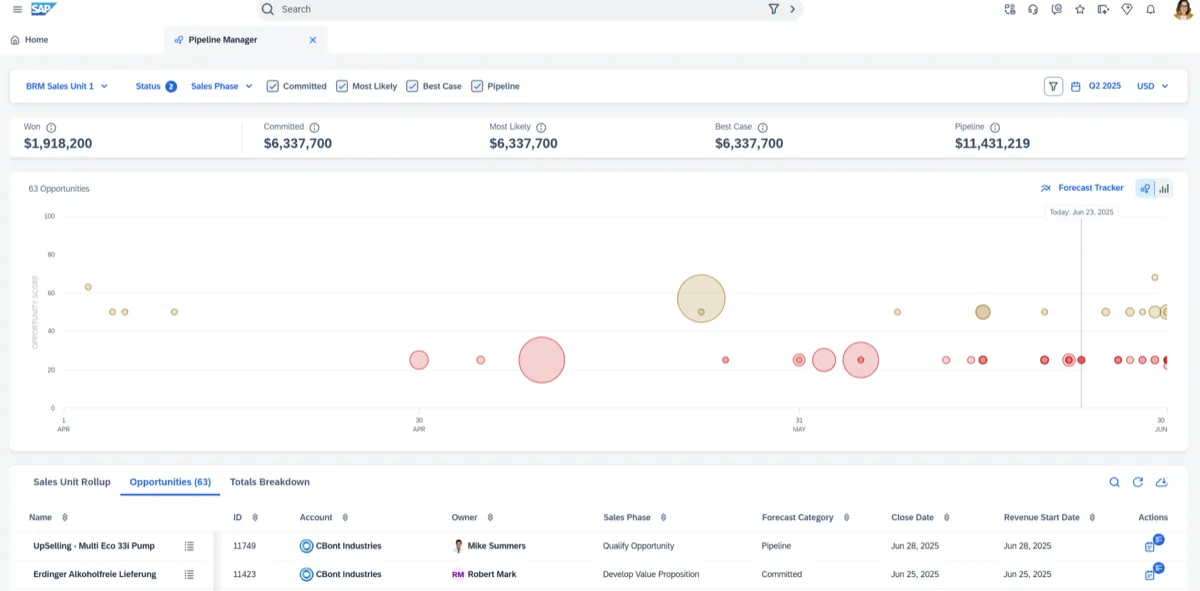
CRM projects fail when the system is configured for leadership reports, not for sales reps. We work the other way around. The first question we ask: what does a rep need to do in the first ten minutes of their day? Everything gets built backwards from there.
The second failure point is data. Dirty data imported from your old system just creates a faster way to make wrong decisions. We include data cleansing and validation as part of every migration — not an optional add-on. If you’re migrating from spreadsheets, see our Excel to SAP Sales Cloud V2 migration guide.
SAP Sales Cloud V2 is a ground-up rebuild, not a feature update. V1 (formerly SAP C4C) entered maintenance mode in 2023. SAP’s active investment — including all Joule AI capabilities — is in V2 only.
| Capability | V1 (C4C) | V2 |
|---|---|---|
| Architecture | Monolithic, customisation via SDK | Composable plug-in extensions — custom logic survives upgrades |
| AI & Joule | Not available | Native: lead scoring, deal intelligence, forecasting, Joule copilot |
| UX | Classic Fiori-style | Modern, mobile-first, responsive |
| Updates | Bi-annual, requires upgrade project | Quarterly, zero-downtime deployment |
| Extensibility | Key User Tools, limited | Plug-in framework, Joule Studio agents, SAP Build integration |
| Guided Selling | Basic | Configurable playbooks for complex B2B processes |
| CTI Integration | Third-party only | Native CTI framework with softphone embedding |
| Mobile | Companion app | Full CRM on any device, online and offline |
If you’re still on V1, our C4C to V2 migration strategy lays out the timeline, risks, and data migration approach. For a deeper feature comparison, read SAP Sales Cloud V2 vs. C4C: What Actually Changed.
SAP Sales Cloud V2 typically costs between $60 and $80 per user per month, depending on volume and contract terms. That positions it well below the main competitors: Salesforce Sales Cloud ranges from $75 to $500 per user per month depending on tier, and Microsoft Dynamics 365 Sales starts at $65 and goes up to $162 per user per month. When you factor in the native S/4HANA integration (no middleware licenses required), the total cost gap widens further in SAP’s favour.
The total cost of ownership depends on your user count, integration scope (S/4HANA, ECC, third-party systems), and implementation complexity. Spadoom offers fixed-price implementation packages — including our CRM in 10 Days package for SMEs — so you know the full investment before signing. For a detailed comparison, see our SAP Sales Cloud V2 vs Salesforce and vs Microsoft Dynamics 365 pages.
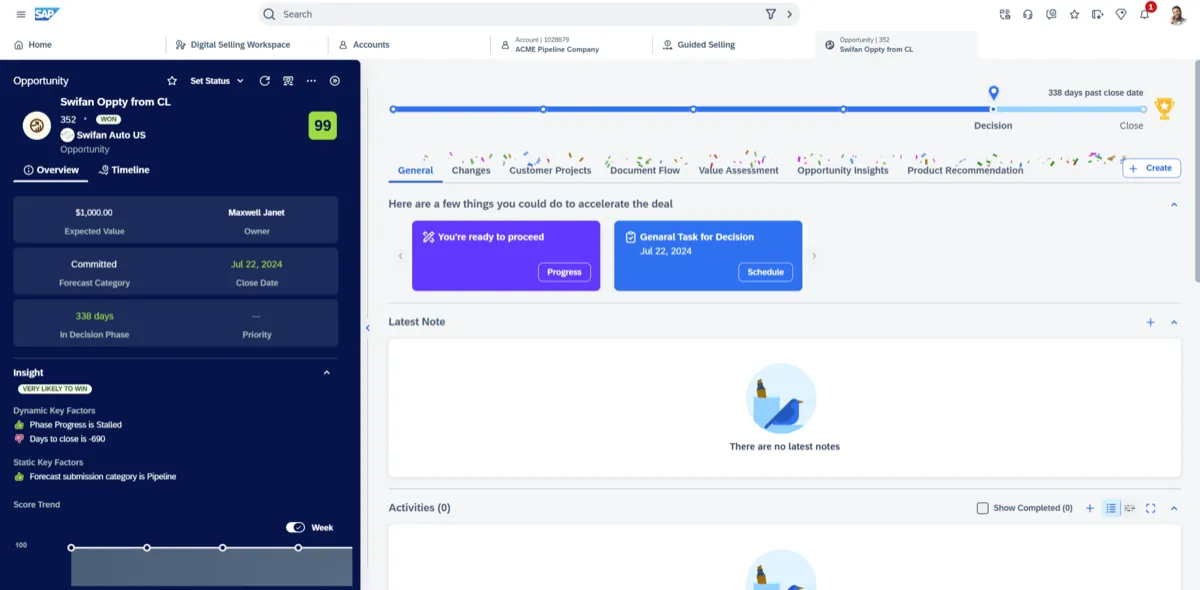
SAP Sales Cloud V2 is built for B2B complexity. Here’s how we’ve deployed it across industries in Switzerland, Germany, Austria, and Italy:
Manufacturing & industrial distribution — The most common fit. Reps need real-time pricing and stock from S/4HANA, configurable product bundles, and multi-level approval workflows. We configure territory management to match regional sales structures common in DACH and Southern Europe.
Medical devices & life sciences — Compliance-heavy sales cycles with regulatory documentation requirements. We set up activity tracking and visit reports that satisfy audit trails, plus integration with quality management data from SAP.
Automotive & high-tech — Long deal cycles, multiple stakeholders, and large-value quotes. Guided selling playbooks walk reps through qualification stages. When paired with SAP CPQ, Sales Cloud V2 handles complex quoting directly in the CRM.
Professional services & consulting — Opportunity-to-project handoffs. We integrate Sales Cloud V2 with project management and resource planning in S/4HANA. The transition from “deal won” to “project kicked off” happens without re-entry.
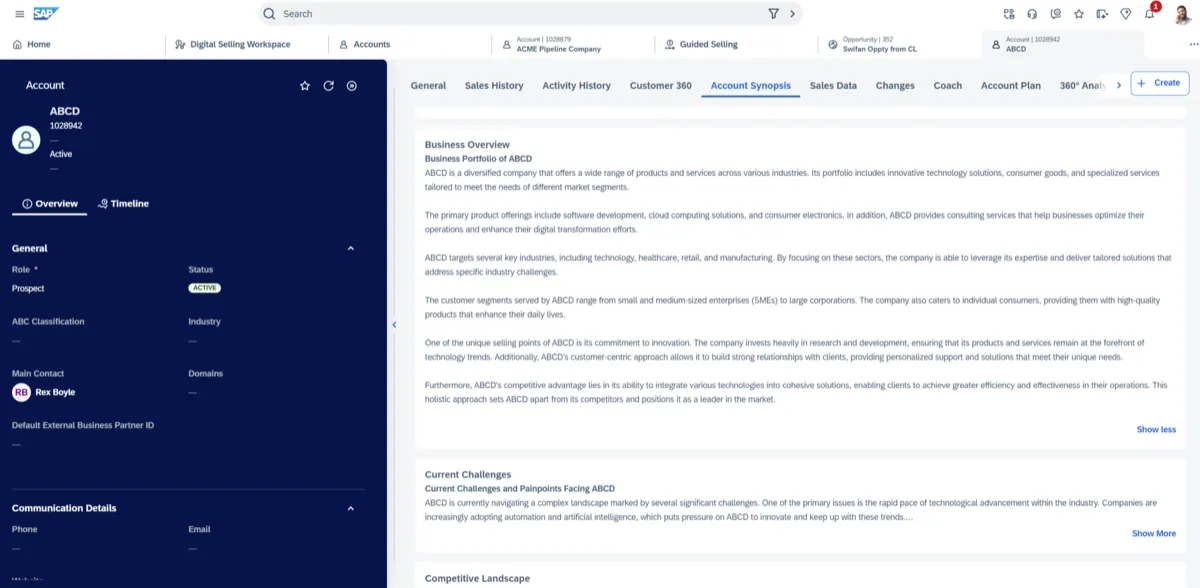
A well-implemented SAP Sales Cloud V2 means:
Six months after go-live, your adoption rate tells the story. We track it, and we’re accountable for it.


SAP Sales Cloud V2 is SAP's cloud-native CRM platform for B2B sales teams. It provides pipeline management, AI-based forecasting, 360° account views, mobile-first access, and native integration with SAP ERP. It is the complete rebuild of SAP C4C / Sales Cloud V1, with a composable plug-in architecture and quarterly zero-downtime releases.
A standard SAP Sales Cloud V2 implementation with data migration and SAP ERP integration takes 8–16 weeks. Spadoom's CRM in 10 Days package deploys the core CRM for SMEs in approximately 10 business days. Enterprise rollouts with multiple territories, complex pipeline configurations, and custom integrations typically run 3–6 months.
SAP Sales Cloud V2 is a ground-up rebuild, not an upgrade. Key differences: a plug-in extension architecture so custom logic survives upgrades; native AI for lead scoring, deal intelligence, and forecasting; a modern mobile-first UX; and quarterly releases with zero downtime. V1 entered maintenance mode in 2023 — SAP's active investment is in V2.
Yes. SAP Sales Cloud V2 has pre-built integration with SAP S/4HANA and SAP ECC, enabling live pricing, stock levels, and order history to flow into the CRM. Spadoom handles these integrations as a standard part of every Sales Cloud V2 implementation.
SAP Sales Cloud V2 is a direct alternative to Salesforce Sales Cloud for B2B organisations — especially those already running SAP ERP or S/4HANA. It offers native ERP integration (pricing, stock, orders), built-in AI forecasting, and a composable plug-in architecture. Companies typically switch when they want a single-vendor CX-to-ERP stack, lower total cost of ownership, and tighter data governance under European regulations.
SAP Sales Cloud V2 is used across manufacturing, industrial distribution, medical devices, automotive, high-tech, and professional services. It is especially strong in B2B environments with complex sales cycles, multi-territory quota management, and a need for real-time ERP data in the sales process. Spadoom has implemented it for clients in Switzerland, Germany, Italy, and Austria.
SAP Sales Cloud V2 typically costs between $60 and $80 per user per month, depending on volume and contract terms. That is significantly less than Salesforce ($75–$500/user/month) or Microsoft Dynamics 365 Sales ($65–$162/user/month). Total cost of ownership also depends on integration scope and implementation complexity. Spadoom offers fixed-price implementation packages — including CRM in 10 Days for SMEs — so you know the full investment before signing. Contact us for a tailored estimate.
Our Sales team has done this before — across manufacturing, retail, and financial services. Let's talk about what's realistic for your situation.
Request a ProposalTrusted by leading European companies










Leave your details and we'll schedule a personalised SAP Sales Cloud V2 & Service Cloud V2 demo for your team.
Your message has been received. We'll be in touch shortly.
Something went wrong. Please try again or email info@spadoom.com.